
Spinoza, Logic, and Geometry
What did he mean by treating geometry as the method of metaphysics?

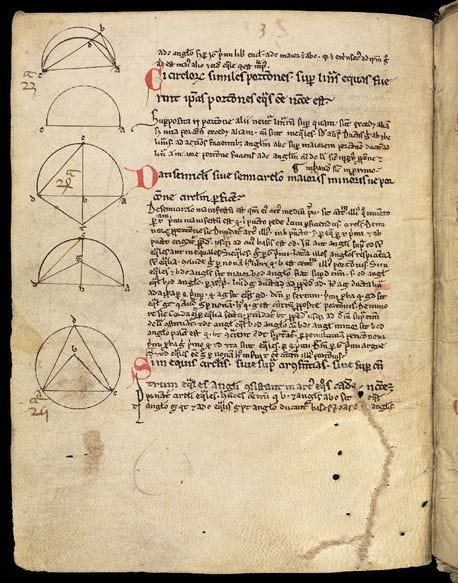
Geometry and Deduction
George Henry Lewes — the husband of Marian Evans (George Eliot), who was the first translator of Spinoza’s Ethics into English — tried to explain why Spinoza was wrong to take geometry as a model for metaphysics:
Geometry never quits the sphere of its first assumption, that its axioms retain their necessary clearness, and its consequences their necessary truth. It begins with lines and surfaces, with lines and surfaces it ends; it is a purely subjective and deductive science (‘Spinoza’s Life and Works’, Fortnightly Review (1843), 214).
This implies, I think, a Lockean view, very standard at the time. To say, e.g., that parallel lines do not intersect is to express a ‘purely subjective’ truth, because it is to say no more than that my idea of parallel lines includes an idea of their not intersecting. This is not to say that my ideas are correct, nor that there are even objects for them to be correct about. Spinoza, using the geometrical method in metaphysics, could hope to tell us about no more than, as Lewes put it, ‘mere certain relations among our ideas’ of God, etc.
This was, at the time, an untenable view of geometry, and the reasons it was untenable are of some historical interest. What does it mean for our ideas of geometrical objects to contain ideas of geometrical properties, expressed in geometrical theorems? One interpretation is that the theorems are logical consequences of the definitions of the objects. As Michael Friedman argued, the syllogistic logics available in the 19C were unable to show this.
Take, Friedman suggests, the very first of Euclid’s propositions: that an equilateral triangle can be constructed with any line (segment) as a base. The proof involves drawing circles around the endpoints of the line, A and B; the intersection of the circles, C, will be the third vertex of an equilateral triangle ABC:
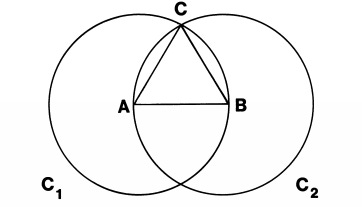
But there are, Friedman points out, models of Euclid’s definitions of ‘line’, etc., in which the proposition can be false because C will not exist. If, for instance, the definitions are interpreted as giving subsets of a discontinuous or non-dense set of points — e.g. the set defined by Cartesian coordinates taking only whole-number or rational-number values — then the intersection C might fall into a gap where there is no point. It is true that lines and circles are defined as continuous in Euclidean geometry, but ‘continuous’ is a non-logical constant that can be assigned various interpretations, for instance ‘consisting of at least two points’. And on some assignments there will be models of the definitions and axioms in which Proposition One is false.
To exclude these models we would need a formal definition of continuity. Then the proposition could be a formal consequence of the definitions and axioms. But syllogistic logic does not permit such a definition because it is, as Friedman puts it, ‘monadic’. That is, it doesn’t allow multiple generality; one quantifier cannot fall within the scope of another.
With multiple generality — the great Fregean innovation — we can define denseness quite easily (continuity can then be defined with the more complex constructions offered by Dedekind or Cantor). With some linear ordering, <, we can say that for any pair of distinct points ordered by < there is a third point between them. But we then need one quantifier to fall within the scope of the other:

With standard syllogistic logic this is impossible. In syllogistic we can write A-propositions (all A are B) and O-propositions (some C is D), but we have no device by which to embed an O-proposition within an A-proposition in the required way (for all A that are B there is some C that is D).
Extended syllogistic logics with quantified predicates will allow us to say, e.g., that all of the As are some of the Bs, but this is equivalent to a conjunction of propositions each involving single generality, not a single proposition involving multiple generality. Ignoring questions of existential import, it is of the form:

when what we needed was the form:

De Morgan was said by A.N. Prior to have taken syllogistic as far as it can be taken, but De Morgan’s formidable battery of conversions with quantified predicates and negative terms still gives no forms of embedded quantifiers.
Geometry could not, then, be readily understood to be a ‘purely subjective and deductive science’ as Lewes had proposed. The deductions couldn’t be explained with the logical resources of the time. And so Lewes’s argument against Spinoza’s attempt to take geometry as a model for metaphysics fails.
Geometry and Intuition
If geometrical theorems can’t be logically deduced from definitions and axioms, then how are they known? A popular answer among 19C Kantians was that the diagrams in the Euclidean demonstrations are indispensable for the proofs, because what the proofs tell us about is the spatial structure we impose upon our perceptions. And the diagrams do give us the right consequences to some degree. E.g. in the diagram above the point C certainly appears to exist. But this doesn’t explain much; why should looking at a single diagram tell us something about all analogous cases?
Some Kantians would reply to this with dark words about space as an a priori form of intuition or something like that. For some of Spinoza’s 19C readers, this was the reason that geometry was an inappropriate model for metaphysics. Geometry is knowable a priori only because it concerns space as the mind’s own structure imposed upon sensory perceptions, whereas metaphysics would concern things in themselves (this is, I think the gist of James Martineau’s argument in A Study of Spinoza — see pp.161–5).
But in the end this Kantian account also fails as an account of geometrical knowledge. One issue is that there are coherently definable functions that defy representation in any spatial ‘intuition’, for example Weierstrass’s continuous but undifferentiable function:
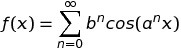
There is no hope of accurately visualising this function. It contains an oscillation within any range however small; any visual image of it will be infinitely inaccurate. Yet it coherently defines a set of points on a Cartesian coordinate plane.
Descartes’s Geometry
What does this have to do with Spinoza? Descartes made a crucial move away from conceiving of geometrical forms as visible constructions. The Geometry of 1637 made a crucial innovation. First, a single numerical value became a segment of a certain length, so that the product of two numerical values would be another length rather than a figure of two dimensions. A two-dimensional figure would then need to be a functional relation between values describing a ‘motion’ within a coordinate plane.
‘Motion’ cannot mean a relation between position and time (since there is no time-variable in the function); I take it to mean a relation between the values of two or more values or a function that maps one to the other. Some such relations will defy any visible representation; they cannot then be identical with such representations.
This to me explains a passage in Spinoza’s Treatise on the Emendation of the Intellect (§95–6) that I struggled to understand for some time. He claims that to define a circle as a figure in which the lines drawn from the circumference to the centre are all equal is to give only a proprium of a circle, whereas defining it as a figure described by any line, one end of which is fixed and the other is movable, gives the proper essence of the circle (and allows for the derivation of all its propria). The latter is what Hobbes would call a ‘genetic’ definition. I did not for some time grasp why Spinoza thought that true definitions had to be genetic in this way.
But if we take ‘motion’ in the mathematical sense I’ve suggested above, the genetic definition matches with the Cartesian functional definition of a circle with centre at (a,b):

The constants a and b are the fixed point, the bound variables x and y are the ‘movable’ end. The equation above gives a certain property of a pair of values (x, y). To define a circle we must take the set of all pairs:

It is this operation — taking the set of values that satisfy a given condition — that corresponds in modern terms to what Spinoza takes to be a genetic and therefore adequate definition, while the condition itself corresponds to what Spinoza takes to be a mere proprium.
If we think of shapes as sets of values for (x, y) — or (x, y, z), etc. for higher dimensions — that satisfy various functions then we reduce geometry to a branch of real analysis. Shapes are sets of real numbers. And we don’t know about these sets by looking at diagrams or considering space as a ‘form of intuition’. We have seen that some functions can’t be visually represented although they define perfectly definite sets.
Nor, however, can we know about these sets by formal deduction from definitions. At least it would not have seemed to Spinoza that we can.
The only available theory of formal deduction was the syllogistic. As I discussed in an article, Descartes had already pointed out, in the Rules for the Direction of the Mind (AT 10.369), that syllogistic can’t even explain ordinary arithmetic inferences . It has no valid form for 2+2=4; 3+1=4 ∴ 2+2=3+1, even though it has forms for 2+2=4; 4=3+1 ∴ 2+2=3+1 (e.g. Barbara, taking singular terms with universal quantity). It has no hope of capturing our knowledge of real analysis.
Cartesian Platonism
As I read Descartes and his followers, they believed that the real explanation of such knowledge consists in the direct grasping of mathematical objects. These must then be taken as real objects not merely produced by the mind, although they might in some sense exist ‘in’ the mind.
Descartes gave only hints about what mathematical objects are; he wrote, for example, in the fifth Meditation that:
when, for example, I imagine a triangle, even if perhaps a figure of this kind exists and will exist nowhere outside my mind, nor will exist, still there is determined some nature or essence or immutable and eternal form of it, which is neither made by me nor depends on my mind (AT 7.64, my translation).
The ‘eternal and immutable essences’ seem to correspond to mathematical objects. A mathematical object, as Henri Poincaré put it (Science and Method, 52), ‘exists provided there is no contradiction implied in its definition’. The Dutch Cartesian, Johannes Clauberg (1622–65), who tried to develop a form of Cartesian logic, gave what looks to be a ‘Platonist’ interpretation of such mathematical objects:
Si illud, de quo cogitamus, nullam involvit in cogitatione nostra repugnantiam … adeo ut judicemus id esse in rerum natura aut saltem esse posse, tunc ei non modo esse objectivum, verum etiam esse reale attribuimus, nec solum νοητόν, intelligibile, sed etiam ἐτόν, reale quid et proprie Aliquid, … appellamus’
[If that which we think does not imply any contradiction in our thought … to the point that we judge that this thing is in nature or at least that it could be, then we attribute to it not only objective being but also real being, and we … call it not only noeton, intelligible, but also eton, some real thing and properly ‘something’] (Metaphysica De Ente 3.18.)
I propose that Descartes and Cartesians in general, including Spinoza, interpreted mathematical objects in this sense. They are things with ‘real being’, existing outside of concrete nature (rerum natura). To know about mathematical objects — e.g. shapes/sets of real numbers — is not simply to know about the formal consequences of nominal definitions. Nor is to know only about our Kantian ‘intuition’ of space, since some such objects surpass what we can represent in our spatial imagination. It is, rather, to come into direct cognitive contact with abstract objects possessing real being.
We know such objects by something akin to perception. Demonstrations, Spinoza claimed, are ‘the eyes of the mind’ (Ethics 5p23s, G2.296). They are not the mere working out of formal consequences. I see Spinoza’s position here as quite close to the one expressed by Gödel:
…despite their remoteness from sense experience, we do have something like a perception also of the objects of set theory, as is seen from the fact that the axioms force themselves upon us as being true [i.e., without being mere formal consequences of presumed definitions]. I don’t see any reason why we should have less confidence in this kind of perception, and more generally, in mathematical intuition than in sense perception (quoted from Hao Wang, A Logical Journey, 226).
Similarly, Ruth Lydia Saw asked, in her book on Spinoza, ‘why should the state we are in when we open our eyes be called knowledge but not the state we are in when we think?’. She meant knowledge of real objects, grasped directly by the mind.
Spinoza’s answer was that it should. Geometrical knowledge was a case in point. And the leading alternative theories of geometrical knowledge in the nineteenth century did not make for a sufficient reply. It should hardly surprise us that Descartes, the inventor of analytical geometry, understood geometrical knowledge better than 19C followers of Mill or Kant. And it is geometrical knowledge as Descartes understood it that inspired Spinoza.
>There is no hope of accurately visualising [Weierstraß's] function
I think there is. Of course, you dont see all the detail at once, but you can imagine what it would look like and what you would see as you keep zooming in. In the same way, we might imagine the "movement" of a parametric curve by putting tiny arrowheads on the line, with the spacing indicating speed, and becoming smaller and more frequent as we zoom in. (The first is literally how I imagine it; for the curve, the speed annotation doesnt "look like" anything in particular, but is there anyway. I think we can natively add speed to still images.)
This might seem like a stretch, but I think its necessary even for more normal visualisations. After all, a true function graph is a line of zero thickness, which you couldnt see; you instead imagine it with a lineweight constant relative to your zoom level. And real physical objects can have infinite detail, too, which doesnt prevent visualsing them.
There are functions that go beyond even this, but theyre a lot uglier than that. For example: for numbers with finite binary expansion, its SHA hash, else 0.
Great stuff Alex - this is right up my alley. I am currently working on Kant on this stuff, especially genetic definition being extended from geometry to metaphysics, and thinking that he got the similar idea of function from Euler rather than Spinoza (oddly, I've just been working out how Kant also has a non-physical notion of motion at play also). I take it that for Kant the appeal to intuition serves not for sensory visualization but the same idea that you are talking about, thought's perception, so maybe they are not separated on that point. For various reasons Kant thinks that it only kicks in when the functions are interpreted/applied by being given a determinate value, and then we see the universal in the particular; whereas maybe for Descartes, Spinoza, and Leibniz it is that the real objects of thought's perception are the more general uninterpreted formulae. Maybe the model of thought's perception is determined by what we think the real objects of thought are, such that the mode of thinking is apt for them....